

Mt. Pleasant celebrates The Workmen's Circle founders after 100 years

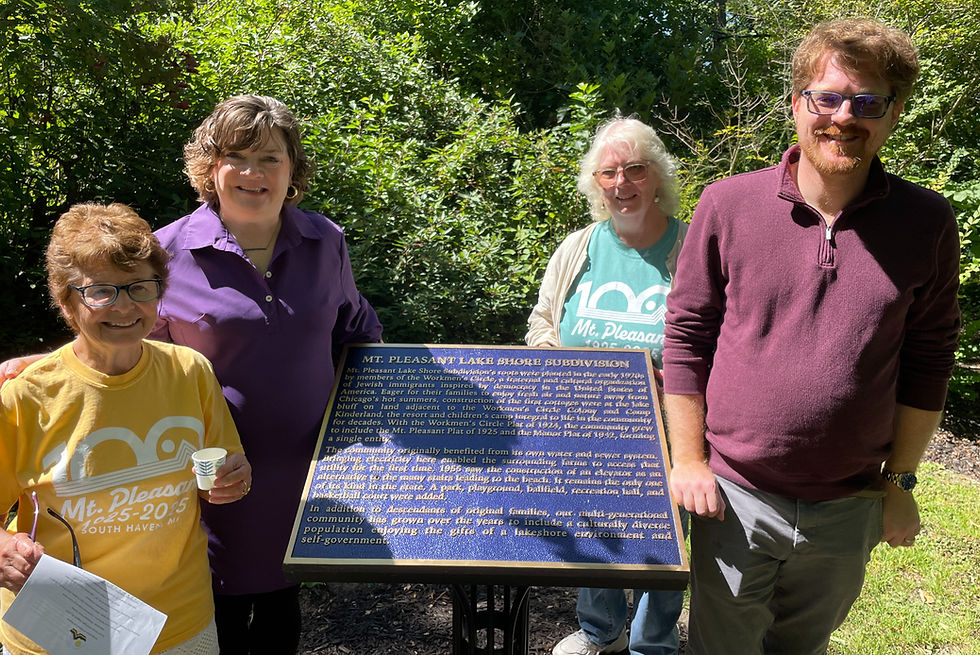
On Saturday August 30 of the Labor Day weekend holiday, about 75 residents of Mt. Pleasant subdivision gathered to dedicate an historical marker honoring their founders, members of The Workmen's Circle. These great grandparents and grandparents of many who now reside full-time or vacation in the lakeshore subdivision established a children's camp, Camp Kinderland on the site between Blue Star Highway and Lake Michigan in Casco Township in 1925. A resort was also established, including small lots for cottages that were sold to Workmen's Circle members, such as Meyer Weinrib, who purchased lots soon after the founding. His granddaughter, Lois Schwartz, who is married to Carl Schwartz, son of founder Alex Schwartz, led the ceremony on behalf of the Centennial Historical Committee.
The Workmen's Circle, also known as The Arbeiter Ring, was a national Jewish labor fraternal order founded a few decades prior to 1925, with 1925 being its peak year of membership. The Workmen's Circle "fought for the right of workers to unionize," Lois Schwartz reminded the crowd, citing examples of Mt. Pleasant ancestors like Ella Schwartz and Chichie Wilks who actively supported and defended striking laborers in keeping with the purpose of The Workmen's Circle.
It was the vision for a better world that spurred the founders to create community. As Lois Schwartz noted, "These were plucky people who escaped the privations, prejudices and violence of the Jewish Pale of Settlement in Eastern Europe. They shared a devotion to the ideal promised by a democratic society in the United States of America. Here they could build lives that offered education, freedom, and opportunities they had been denied. Above all, they wanted these things for the 'kinder'--for their children."
And the children responded. Descendants of founders including Brad Greenspan, Adam Glueckert, Ben Pugsley, and Elsa Wretzky Langlois took turns reading the text on the historical marker:
Mt. Pleasant Lake Shore Subdivision
Mt. Pleasant Lake Shore Subdivision's roots were planted in the early 1920s by members of the Workmen's Circle, a fraternal and cultural organization of Jewish immigrants inspired by democracy in the United States of America. Eager for their families to enjoy fresh air and nature away from Chicago's hot summers, construction of the first cottages were at the lake bluff on land adjacent to the Workmen's Circle Colony and Camp Kinderland, the resort and children's camp integral to life in the community for decades. With the Workmen's Circle Plat of 1924, the community grew to include the Mt. Pleasant Plat of 1925 and the Manor Plat of 1942, forming a single entity.
The community originally benefited from its own water and sewer system. Bringing electricity here enabled the surrounding farms to access that utility for the first time. 1955 saw the construction of an elevator as an alternative to the many stairs leading to the beach. It remains the only one of its kind in the state. A park, playground, ballfield, recreation hall, and basketball court were also added.
In addition to descendants of original families, our multi-generational community has grown over the years to include a culturally diverse population enjoying the gifts of a lakeshore environment and self-government.

Mayor Annie Brown of the City of South Haven presented a proclamation congratulating the residents of Mt. Pleasant for "honoring its heritage while creating its future," concluding her remarks by quipping that the residents had created "a home of chutzpah in a neighborhood of mensches."

State Representative Joey Andrews presented a proclamation from the State of Michigan, signed by Governor Gretchen Whitmer, noting not only the cultural and social attributes of the community of Mt Pleasant subdivision, but also its innovations, including a bluff elevator, electricity, and a sewage system.
Casco Township resident Will Hart was recognized for his work in fabricating and installing the metal pedestal that held the historical plaque. In his brief remarks, Hart said, "I'm just the shamash; the most important things humans can do is form community."

As a closing exercise in community, Lois Schwartz led the crowd in a chorus and a toast. With lyrics in Yiddish, the simple song toasted the ancestors of The Workmen's Circle, celebrated the present, and looked to its future generations to continue the work of "building a better and more beautiful world," as Lois Schwartz urged those gathered.


Comments